Yosemite Backpacking Map: Trail Maps, Permit Zones & Route Planning Guide
Key Takeaways
- Invest in both paper and digital maps for comprehensive Yosemite backpacking route planning
- Wilderness permits are zone-based with varying availability; popular zones require booking 5 months in advance
- Tom Harrison Maps and National Geographic Trails Illustrated are industry standards for backcountry navigation
- CalTopo and Gaia GPS allow custom route planning and offline trail navigation with topographic overlays
- Understanding contour lines and elevation profiles is essential for safe daily mileage planning
- Bear canister requirements vary by permit zone and must be confirmed on your map before departing
Why You Need a Dedicated Backpacking Map for Yosemite
A dedicated Yosemite backpacking map is far more than a novelty it's an essential tool for safe, successful wilderness travel.
Unlike standard tourist maps, specialized Yosemite trail map resources provide the elevation detail, backcountry trail accuracy, and permit zone information necessary for multi-day expeditions in one of America's most challenging alpine environments.
Yosemite's 1,200 miles of trails traverse dramatically varied terrain, from granite peaks above 13,000 feet to sequoia groves and river canyons.
A quality Yosemite backpacking map displays contour intervals, water sources, established campsites, and permit zone boundaries critical details omitted from day-hiking maps. Without proper mapping tools, backpackers risk navigating confusing junctions, overestimating daily mileage capacity, and violating wilderness permit regulations.
The park's bear canister requirements, varying by zone, must be verified against your planned route before departure.
Topographic maps clearly delineate these zones, allowing you to confirm your equipment needs and adjust your itinerary accordingly.
Day Hiking Maps vs. Backcountry Trail Maps
Day-hiking maps, typically available free at visitor centers, show major trailheads and popular valley-based routes.These are simplified for casual use and lack the detail required for remote backpacking.
A Yosemite backpacking map, by contrast, provides 1:24,000 or 1:25,000 scale topography showing every contour line, unmarked spurs, seasonal water sources, and backcountry campsites.
Backcountry maps include permit zone boundaries overlaid on topographic basemaps, allowing you to verify which watershed you're entering and whether high-altitude bear canisters are mandatory. They often feature elevation profiles for specific routes, helping you plan realistic daily mileage based on terrain difficulty, not just distance.
For Yosemite backpacking routes lasting more than one day, specialized maps are non-negotiable. They transform route planning from guesswork into data-driven preparation.
Yosemite Wilderness Permit Zone Map Explained
The Yosemite wilderness permits system divides the park into distinct zones, each with a specific daily trailhead quota and seasonal availability. Understanding these zones on your map is fundamental to planning a successful Yosemite backpacking trip. The park manages nearly 750,000 acres of wilderness, and permits cap daily entry at 180 people per day valley-wide, distributed across multiple zones.
A comprehensive Yosemite wilderness map color-codes these zones, allowing you to identify permit alternatives if your first-choice trailhead is full. The Tuolumne Meadows zone, for example, is dramatically more competitive than remote eastern Sierra entry points. Strategic map reading reveals less-crowded access points to similar destinations.
How Trailhead Quotas Work by Zone
Each wilderness permit zone has a daily quota of backpackers who can depart. Popular zones like Tuolumne Meadows and Half Dome have quotas between 20–40 people per day, while remote zones might allow only 8–12. Once a zone reaches its quota, no additional permits are issued for that day.
The NPS releases 60% of permits five months in advance via lottery, with the remaining 40% available 24 hours prior. If Half Dome zone (quota: 40/day) is booked solid for your desired dates, your map helps you quickly identify alternatives like Cathedral Lakes or Glen Aulin, which may have availability on the same departure date.
Understanding quota mechanics allows sophisticated route planning: you can plan a seven-day loop that exits one zone and enters another, effectively increasing your flexibility within park regulations.
Most Popular Permit Zones and Availability Tips
Tuolumne Meadows, Half Dome, and Cathedral Lakes zones consistently reach maximum capacity during summer months. These areas offer iconic destinations and developed trail systems. For July-September travel, secure permits five months in advance (January-April dates) or plan alternatives.
Less-crowded alternatives mapped near these zones include Glen Aulin (via Waterwheel Falls), North Tuolumne (Gaylor Lakes entry), and High Sierra Camp loops. Shoulder seasons June and September offer dramatically better availability. Eastern Sierra entries (Mono Pass, Tioga Pass regions) often have availability even in peak season.
Your Yosemite backpacking map should annotate these zone boundaries, allowing you to rapidly assess permit availability trade-offs. A slightly longer hike from a less-crowded trailhead often yields superior wilderness solitude.
Best Paper Maps for Yosemite Backpacking
Paper maps remain indispensable for Yosemite backcountry navigation. Unlike digital devices, paper maps never lose battery, don't depend on satellite reception, and provide a tactile, comprehensive overview of your entire route.
Here are the industry-leading options:
Tom Harrison Yosemite High Country Trail Map
Tom Harrison Maps are the gold standard for Yosemite backpacking. The "High Country" edition covers the northern Sierra region at 1:63,360 scale, making it portable while maintaining exceptional detail. These maps include established campsites, water sources, permit zones, and estimated mileages between landmarks.
The cartography reflects decades of local knowledge. Seasonal water sources are annotated, and challenging terrain is clearly differentiated from maintained trail. Backcountry-specific features like ranger stations and emergency shelter locations are marked.
At approximately $12–15 per map, they're an excellent value for serious Yosemite backpacking trips.
National Geographic Trails Illustrated: Yosemite National Park
National Geographic's Trails Illustrated series maps are waterproof and printed on durable material essential for multi-day wilderness travel. The Yosemite edition covers the entire park at 1:63,360 scale, allowing you to visualize your entire Yosemite backpacking route on a single sheet.
These maps display wilderness permit zones with distinct colors, making zone verification simple. Contour intervals of 40 feet provide sufficient detail for route planning, though the scale requires careful interpretation of terrain steepness. The waterproof material is worth the premium if you're hiking in unpredictable weather.
USGS 7.5-Minute Topographic Quads
USGS 7.5-minute topographic quads are the most detailed maps available, with 1:24,000 scale and 40-foot contour intervals. They reveal terrain features that larger-scale maps omit. However, they cover small areas (approximately 6.5 x 8 miles), requiring multiple sheets for extended Yosemite backpacking routes.
For serious backcountry navigation and route-finding in off-trail terrain, USGS quads are unmatched. Free digital versions are available through the USGS Top o View website; printing those you need creates a lightweight, detailed navigation package.
Most serious Yosemite backpackers combine Tom Harrison maps for overall planning with USGS quads for complex terrain sections.
Best Digital & App-Based Maps for Yosemite Backcountry
Digital mapping apps have revolutionized route planning. The advantage of Yosemite backpacking map apps lies in their flexibility: you can zoom, measure distances, overlay multiple data layers, and share routes with companions. Most importantly, quality apps offer offline functionality essential in areas without cell service.
CalTopo: Custom Route Planning & Topo Overlays
CalTopo is the premier choice for Yosemite backpacking route planning. Its web interface allows you to digitally draw your intended route, instantly generating elevation profiles, total mileage, and terrain analysis. You can overlay topographic maps, satellite imagery, and custom data layers (including NPS permit zones).
The platform excels at rapid iteration: sketch a route, review the elevation profile, adjust waypoints to optimize daily mileage, and share your plan with hiking partners. CalTopo's mobile app downloads maps for offline use, and integration with wearable GPS devices allows real-time tracking. Premium subscriptions ($40/year) unlock unlimited custom imports and cloud storage.
For detailed yosemite backpacking itinerary planning, CalTopo is unmatched. You'll invest 2–3 hours initially, then have a precise, data-driven route.
Gaia GPS & AllTrails: Offline Trail Navigation
Gaia GPS and AllTrails both offer extensive trail databases and offline map downloads. Gaia GPS ($39.99/year premium) provides USGS topographic basemaps, satellite imagery, and user-contributed trails. AllTrails ($35.99/year) focuses on crowdsourced trail ratings and conditions, with integrated offline maps.
For Yosemite backpacking, Gaia GPS has a slight advantage due to its topographic accuracy and customization options. Pre-load your entire route before entering the wilderness, and the app tracks your GPS position in real time. Both apps support GPX file imports, allowing you to synchronize routes created in CalTopo.
NPS Yosemite App & Free Digital Resources
The official NPS Yosemite app provides maps, permit information, and real-time alerts. While it covers major trails adequately, it lacks the detailed topographic overlays necessary for serious backcountry planning. Use it as a supplementary resource.
Free resources include USGS TopoView (downloadable USGS quads), OpenStreetMap overlays in various apps, and Yosemite's website PDFs of permit zones. These free options, while less polished, suffice for basic planning when combined with Tom Harrison paper maps.
Top Yosemite Backpacking Routes with Map References
Here are four classic Yosemite backpacking routes with specific map references and navigation considerations:
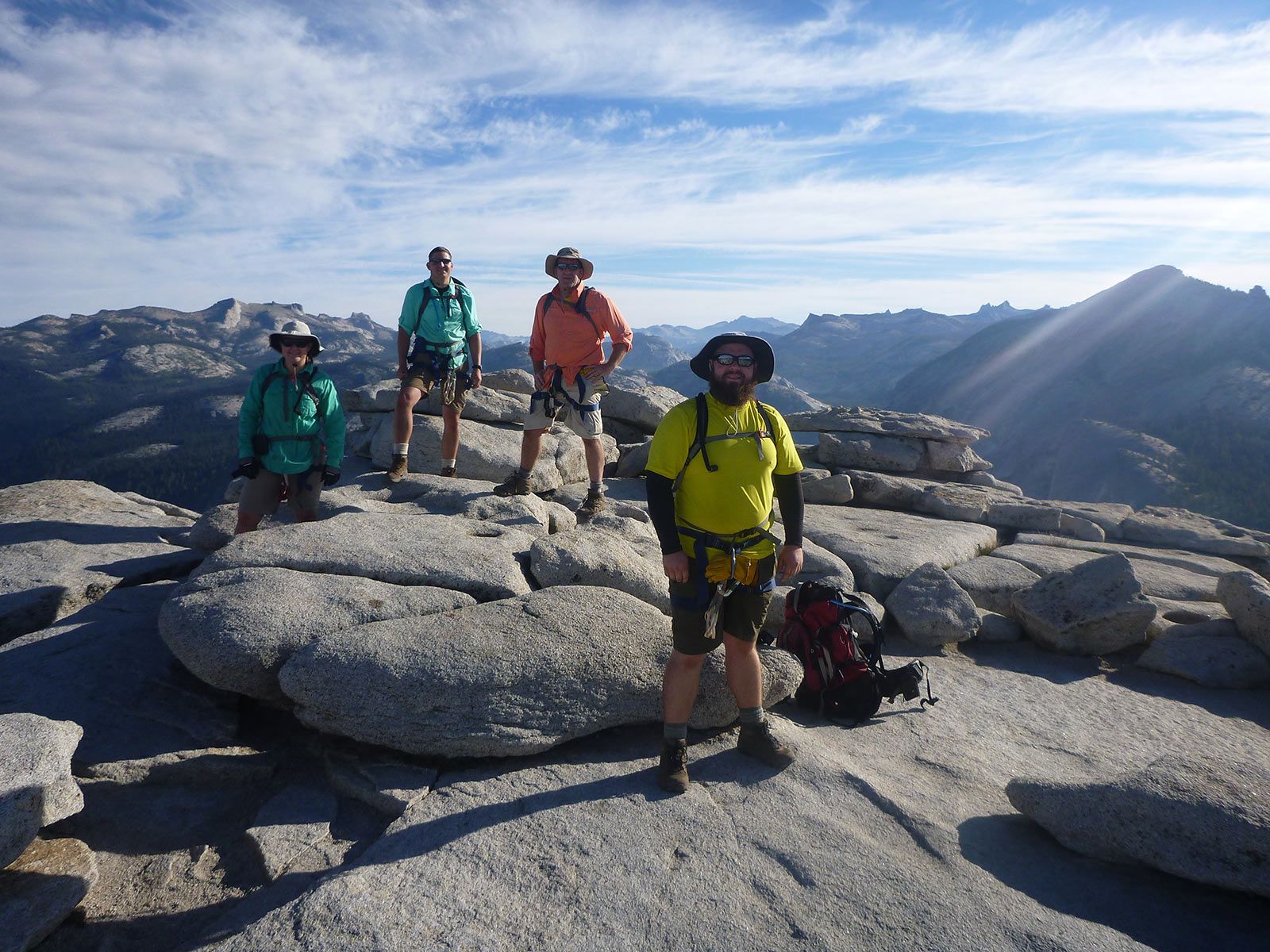
Clouds Rest & Half Dome Loop (2-3 Days)
This 18-mile loop combines two of Yosemite's iconic peaks. Begin at Tenaya Lake trailhead (on Tom Harrison "High Country" map), ascend Clouds Rest (10,308 ft), descend to Half Dome backpacker campsite, then return via Mist Trail. Daily mileage: 9 miles Day 1, 9 miles Day 2.
Map considerations:
The descent from Clouds Rest to Tenaya Lake Junction involves some route-finding; your map must clearly show the established trail switchbacks.
Check for seasonal water availability around Clouds Rest summit before departure.
For a detailed guide to this route, see our
Clouds Rest and Half Dome guided backpacking trip.
Cathedral Lakes to Tuolumne Meadows (1-2 Days)
A 14-mile route (one-way) from Tenaya Lake to Tuolumne Meadows via Cathedral Lakes.
This yosemite backpacking trail showcases dramatic granite basins and subalpine lakes.
Daily mileage: 7 miles Day 1 to Cathedral Lakes, 7 miles Day 2 to Tuolumne Meadows.
Map essentials: Clearly mark Cathedral Lakes' three main lakes on your yosemite wilderness map; many hikers confuse Lower and Middle Cathedral Lakes.
Water is abundant throughout this route.
The final descent to Tuolumne Meadows can be steep verify the switchback route on your map before hiking.
Grand Canyon of the Tuolumne (3-5 Days)
A spectacular 28-mile route descending into the Tuolumne River canyon, then following the river upstream through granite wilderness. This Yosemite backpacking route requires careful permit planning: entry and exit zones differ, affecting availability.
Map critical details: Identify water sources along the river corridor (reliable) versus alpine sources at higher elevations (seasonal).
Your Yosemite backpacking map must clearly show three major river crossings and their difficulty ratings.
Navigation difficulty increases during snowmelt; summer (July–August) is optimal.
High Sierra Camp Loop (5-7 Days)
A 50-mile loop connecting five backcountry camps (Glen Aulin, May Lake, Sunrise, Cathedral, and Clouds Rest).
This Yosemite backpacking route is achievable for fit hikers and requires strategic permit selection across multiple zones.
Map strategy: Your route must show all five camp locations, daily mileage targets (8–10 miles/day), and bear canister zone boundaries.
The High Sierra Camp Loop requires excellent elevation profile reading to ensure realistic daily mileage across multiple 9,000+ foot passes.
How to Read a Topographic Map for Yosemite Backcountry
Topographic map literacy is essential for safe Yosemite backpacking. A topo map displays terrain in three dimensions through contour lines curved lines representing constant elevation.
Learning to interpret these lines transforms your navigation confidence and route-planning accuracy.
Understanding Contour Lines and Elevation Gain
Each contour line represents a specific elevation, typically 40 feet apart on 1:24,000 USGS maps (100 feet on 1:63,360 maps like Tom Harrison). Closely spaced contours indicate steep terrain; widely spaced contours show gentle slopes.
To calculate elevation gain over a specific Yosemite backpacking route segment, trace your planned route and count the contour lines you cross. Multiply by the contour interval (40 or 100 feet). A route crossing 30 contours on a 1:24,000 map represents 1,200 feet of elevation gain challenging terrain requiring realistic mileage planning.
Visual patterns matter: V-shaped contours indicate stream valleys; circular concentric contours indicate peaks or summits.
Saddles (low points between peaks) appear as gentle dips in contour patterns.
Identifying Water Sources, Campsites, and Trail Junctions
Quality Yosemite backpacking maps annotate critical features:
- Water sources appear as blue lines (streams) or small blue dots (springs). Solid blue lines are reliable year-round; dashed lines are seasonal. Plan daily mileage between water sources never plan dry stretches in Yosemite's alpine terrain.
- Established backcountry campsites are marked with small symbols (often a tent icon on specialized maps).These are regulated by the NPS; wild camping outside designated sites is prohibited in Yosemite wilderness.
- Trail junctions are shown as where solid lines intersect. Ensure your map distinguishes maintained trails from social trails. Many off-trail routes in Yosemite are user-created and unstable.
Map-Based Planning Tips for Yosemite Backpackers
Planning Daily Mileage Using Elevation Profiles
A 10-mile day on Yosemite's relatively flat valley floor is dramatically different from a 10-mile day climbing 3,000 feet to alpine terrain. Elevation profiles visual representations of terrain difficulty are essential for realistic planning.
Digital tools like CalTopo automatically generate elevation profiles as you draw your route. For paper maps, manually sketch elevation profiles by identifying major climbs and descents along your planned daily segments.
A good rule of thumb: expect to cover 2 miles per hour in flat terrain, 1 mile per hour climbing at elevation, and 2–3 miles per hour descending.
Example calculation: An 8-mile Yosemite backpacking day with 2,000 feet of elevation gain breaks down as follows: 4 miles flat (2 hours) + 2 miles climbing (2 hours) + 2 miles descending (1 hour) = 5 hours of actual hiking, plus breaks and camp setup. This is moderately challenging for most backpackers.
Navigating Yosemite's Bear Canister Requirements by Zone
Bear canister regulations vary significantly by permit zone. Some zones require bear canisters at all elevations; others only above 9,600 feet. Your Yosemite backpacking map must clearly indicate these zone boundaries so you can verify equipment requirements before purchasing or renting.
Cross-reference your route against the NPS Wilderness Permit Zone map (available on Yosemite.org and included with quality paper maps). If your five-day itinerary traverses two zones with different bear canister rules, you must comply with the most restrictive rule for your entire trip.
Failure to comply results in permit denial. Verification is part of the permit-issuance process, so ensure your map analysis matches the park's official zone boundaries.
Frequently Asked Questions
Can I use my smartphone GPS instead of a physical map?
Smartphones are excellent tools, but they fail: batteries die, water damage occurs, and reception is nonexistent in deep canyons.
Always carry a paper map as a backup. Many experienced backpackers use both paper and digital in tandem.
Which single map should I buy for Yosemite backpacking?
The Tom Harrison Yosemite High Country map is the best single purchase for versatility and backcountry detail.
It covers the most popular wilderness zones, includes permit zone boundaries, and balances portability with sufficient scale detail.
How do I know if my planned route respects bear canister zones?
Download the official NPS Yosemite Wilderness Permit Zone map from Yosemite.org and overlay it with your route using digital tools (CalTopo, Google Earth) or by manually comparing your paper maps.
Verify you don't traverse both canister-required and canister-optional zones; if you do, canisters are mandatory for the entire trip.
Are USGS topo quads sufficient for all Yosemite backpacking?
USGS quads are excellent for navigation, but they lack permit zone overlays and established-campsites annotations.
Combine USGS quads with a regional map that includes wilderness permit information for comprehensive planning.
What's the best way to prepare for high-altitude backpacking in Yosemite?
Map reading is one component.
Ensure your yosemite backpacking itinerary includes acclimatization days at intermediate elevations, realistic daily mileage targets, and substantial physical training.
For detailed guidance, see our resource on preparing for high-altitude backpacking.
Conclusion
A comprehensive Yosemite backpacking map is the foundation of safe, successful wilderness travel.
Whether you choose paper maps, digital tools, or a combination, investing in quality cartography ensures you can verify permit zones, identify water sources, calculate realistic daily mileage, and navigate Yosemite's complex backcountry with confidence.
Pair your maps with proper planning, permit application strategy, and physical conditioning, and you'll be prepared for an unforgettable wilderness experience.
Ready to begin planning your Yosemite backpacking adventure? Start by downloading or purchasing one of the recommended maps, identify your ideal route, and submit your wilderness permit application at least five months in advance for popular zones.
Four Season Guides, 506 N Grant St suite o, Flagstaff, AZ 86004, United States
+19285251552
35.19653980, -111.62000560
Read More